The case in one reading
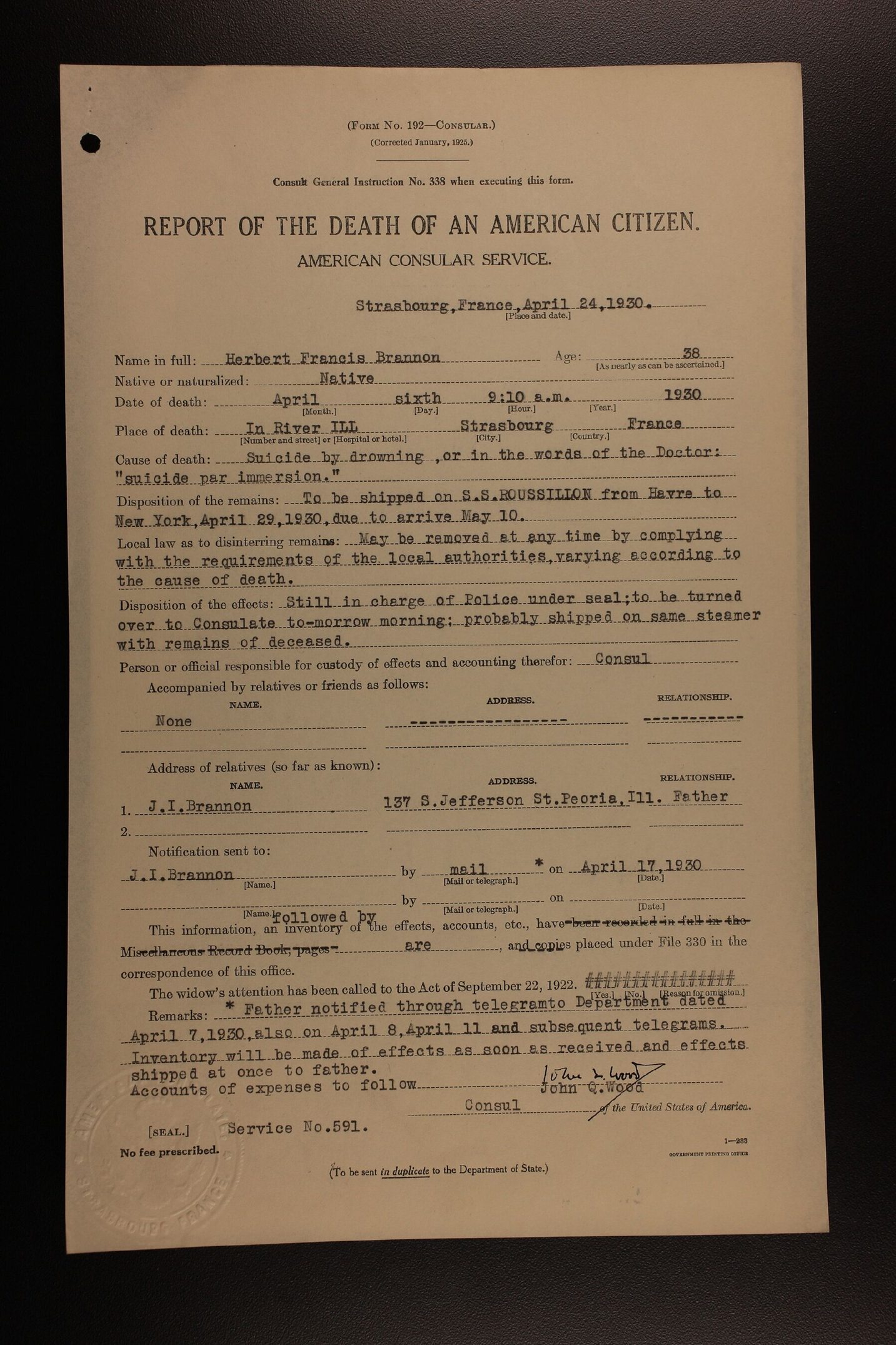
Herbert Franklin Brannon died by drowning in Strasbourg’s River Ill on April 6, 1930. The United States consular death report explicitly classified the death as suicide. The surviving inquiry describes an intentional entry into the river after a night of unusual behavior. It does not establish why he entered, whether he intended to die, or whether alcohol, illness, or another impairment contributed. Those are separate questions, and the records answer them with different degrees of certainty. Consular p. 39 Consular p. 42 Consular p. 43 Consular p. 44
The strongest biographical identification is an Illinois lawyer, University of Illinois law graduate of June 17, 1914, and U.S. Naval Reserve yeoman. He married Louise Carmen Buchner in Ottawa on February 25, 1922. A newly examined 1940 census records a widowed Martha Brannon and a ten-year-old James S. Brannon with the couple strongly identified as Herbert’s parents. That is substantial support for the family’s research direction; it is not yet a record naming Herbert as Martha’s husband or James’s father. Degree minutes, 1914 War directory, 1918 Wedding report, 1922 1940 census
The investigation also changes the search for his book. His effects contained ten copies of The Philosophy of Voluntarism. Nine copies were included among the effects received by his father. One was retained in Strasbourg with other books and subsequently disposed of. A family copy is therefore a concrete provenance lead, although no surviving copy or title page has been located. Consular p. 35 Consular p. 7 Consular p. 4 Consular p. 2
Drowning · April 6
The recovered body, inquest report, and consular record establish the core event.
Suicide
The form states it explicitly. The label must remain part of the case.
Intent and motive
The available evidence does not disclose his precise purpose or explain the episode.
What this investigation adds
| Addition | What it changes |
|---|---|
| 1914 university governing-board minutes | Establish the degree-conferral date; the 1915 Illio label had obscured it. |
| April 1915 alumni journal | Reports that Brannon passed the state bar examinations at Ottawa in late February 1915. Formal admission remains to be documented. |
| January 15, 1918 wartime directory | Provides a dated contemporary report of his USNR yeoman service. |
| Original 1940 census sheet | Replaces a previously unverified family lead with an inspectable household record. |
| Marriage-file index locators | Identify Herbert and Louise’s certificate 2863, and a tentative parental candidate, certificate 6208. These are locators, not newly obtained marriage certificates. |
| A complete reading of the 68-page consular packet | Restores the explicit suicide classification; separates witness reports from later conclusions; traces the nine books sent home; reconciles recovery and return expenses. |
The first three are newly located primary publications. The census is a newly obtained original image confirming an earlier lead. The marriage entries are derivative indexes to original files. The consular findings are new deductions from material already supplied. The sections below show the evidence for each addition.
Identity, education, and professional life
The university’s 1918 Semi-Centennial Alumni Record, entry 6105, is the most useful compact identity anchor. It names Herbert Franklin Brannon, an LL.B. and lawyer; gives March 11, 1892, St. Louis as his birth; names his father as J. I. Brannon; records preparation at Streator High School, Kappa Sigma and Phi Delta Phi membership, and service as a Yeoman, U.S.N.R. His listed address is 705 N. Jefferson Street, Peoria. This is contemporary institutional evidence, but it is not a civil birth certificate. Alumni record, 1918
Entry 6105 names Herbert Franklin, his father, the birth claim, affiliations, naval designation, and Peoria address.
Alumni record, 1918The name Franklin is supported by the university record, the law-degree list, and the law-senior page. The consular death form instead expands the name to Herbert Francis Brannon. The Ottawa wedding article prints Herbert P. Brannon, while the marriage-file index gives Herbert Franklin. The recurring family, educational, geographical, and event details make clerical or reporting variation a much stronger explanation than several different men. These variants should remain in search requests rather than being silently corrected inside transcriptions. Degree minutes, 1914 Illio, law seniors Consular p. 39 Wedding report, 1922 Groom index
A chronology supported by contemporary records
| Date | Established record | Interpretation and limit |
|---|---|---|
| 1892 | The 1918 alumni entry gives March 11, St. Louis. | Working birth identification. An April 8, 1930 French newspaper gives May 11, Chicago; a civil birth record is still needed. Alumni record, 1918 French report, April 8 |
| Before the Illinois law degree | The alumni record names Streator High School; the law-senior page names Lake Forest College. | Supports a Streator–Lake Forest–Illinois educational path. The wedding article calls Lake Forest an academy; no separate Lake Forest degree is established. Alumni record, 1918 Illio, law seniors Wedding report, 1922 |
| June 17, 1914 | University trustees’ minutes list Herbert Franklin Brannon among Bachelor of Law recipients. The date appears at the start of the degree list. | Degree date established by the institution’s governing record. Degree minutes, 1914 |
| Late February 1915 | The April alumni journal reports H. F. Brannon and A. V. Essington passing the state bar examinations at Ottawa. | Examination passage, not an independently established admission date or license number. Essington appears beside Brannon in the degree list, strengthening the identification. Bar notice, 1915 Degree minutes, 1914 |
| By January 1918 | The January 15 war-directory supplement lists Herbert F. Brannon, class of 1914, as USNR, Yeoman. | Contemporary service report. Its December 7–January 7 reporting window is not an enlistment window. No station, ship, deployment, or combat service is specified. War directory, 1918 |
| 1918 | The alumni record places him at 705 N. Jefferson, Peoria, and repeats the naval designation. | A second institutional source for identity and service; neither substitutes for his personnel file. Alumni record, 1918 |
| February 25, 1922 | The wedding report calls him a Peoria attorney with Scholes, Pratt & Brannon, practicing there for five years. | Supports practice around 1917–1922, allowing for the article’s rounded retrospective wording. Wedding report, 1922 |
| By April 1930 | A preserved text capture attributed to the New York Times reports a Chicago office at 160 N. LaSalle Street and an increasing interest in philosophical writing. | Useful contemporary attribution, but the original newspaper page was not obtained in this investigation. A Chicago directory or professional record is needed to firm up the late-career chronology. NYT text capture |
Printed p. 74 establishes the date for the degree list.
Degree minutes, 1914Printed p. 78 lists Herbert Franklin Brannon under Bachelor of Law.
Degree minutes, 1914April 1915 alumni journal, p. 160. Reports examination passage by H. F. Brannon and A. V. Essington.
Bar notice, 1915Wartime directory, January 15, p. 171. Brannon’s entry is at the bottom right.
War directory, 1918The graduation correction matters. The 1915 Illio contains his law-senior entry and portrait, but the official minutes record the degree under June 17, 1914. An annual’s title year is weaker evidence for conferral than the actual degree list. The earlier fraternity photographs and rosters remain useful identification context; satirical student material cannot responsibly establish his adult temperament or explain his death. Illio, law seniors Degree minutes, 1914
The Ottawa marriage: a firm family anchor
The February 25, 1922 Free Trader-Journal and Ottawa Fair Dealer is especially valuable because it joins the professional and family identities in one detailed, contemporary account. It reports a wedding at high noon that day, at the Buchner home, 539 East Main Street, Ottawa. The headline’s reference to Peoria describes the groom’s association; it does not relocate the ceremony. Wedding report, 1922
February 25, 1922, page 1. Preview of the clipping; open it to read the complete account.
Wedding report, 1922| Detail | What the wedding article actually supplies |
|---|---|
| Bride | Louise Carmen Buchner, only daughter of County Recorder John F. Buchner and Mrs. Buchner. |
| Groom | Attorney Herbert P. Brannon as printed; the surrounding biography identifies the Herbert Franklin Brannon of the university records. |
| Ceremony | Rev. George W. Farrar, Christ Episcopal Church; no attendants; a dinner for sixteen immediate relatives. |
| Herbert’s parents | Mr. and Mrs. J. I. Brannon, formerly of Streator, said to have moved to Peoria seven years earlier. |
| Career | Five years of Peoria practice; firm Scholes, Pratt & Brannon. |
| Louise’s background | Washington School and Ottawa Township High School; work in her father’s courthouse office during the preceding two years. |
| Travel and home | Afternoon train to Chicago, then New York for a two-week honeymoon; an apartment prepared at 201 Greenleaf, Peoria. |
The article documents a public, family-attended marriage with a planned shared household. It does not establish how long the marriage lasted. Earlier and later Ottawa notices place Louise with Herbert’s parents before the wedding and refer to Mrs. Herbert Brannon in the subsequent social record, including a notice at the end of 1922. These reinforce the marriage identification without extending it automatically to 1930. Ottawa social notices
New record locator: the LaSalle County Genealogy Guild’s groom index, p. 144, lists certificate 2863, Herbert Franklin Brannon and Louise Carmen Buckner, February 25, 1922. The bride index repeats it on p. 174. This corroborates the date and supplies a route to the original license, affidavit, and return. The spelling difference, Buchner/Buckner, must be retained in the request. The original certificate has not yet been inspected. Groom index Bride index
A completed return may provide parents’ names and the bride and groom’s birthplaces, making this a particularly efficient next record: it could resolve both the marriage details and some identity questions. The guild describes the contents and availability of its original marriage packets. Marriage-record collection
Martha, James, and the family connection
The family research identifies James Schofield Brannon as the descendant through whom Herbert is being investigated, and Martha Hoerr as James’s mother. Those supplied identifications guide the search. The newly located census supplies an important piece of documentary support, while leaving a specific relationship gap.
The original 1940 census, Peoria, enumeration district 104-31, sheet 6B, lines 49–52, records the following household at 137 Ford Street, visitation number 178. It was enumerated April 19. The address is read across the household and the preceding sheet; it is a different address from the father’s 137 S. Jefferson Street in the 1930 consular correspondence. 1940 census Census address context Consular p. 39
ED 104-31, sheet 6B, lines 49–52. James I., Georgianna, Martha, and James S.; household 178.
1940 census| Name as recorded | Relationship to head | Age | Marital status | Birthplace |
|---|---|---|---|---|
| James I. Brannon | Head | 72 | Married | Indiana |
| Georgianna Brannon | Wife | 70 | Married | Iowa |
| Martha Brannon | Daughter-in-law | 36 | Widowed | Utah |
| James S. Brannon | Grandson | 10 | Single | Illinois |
All four are recorded in the same place in 1935, meaning the same locality, not necessarily the same house. James I. is recorded as managing his own billiard parlor. Martha is a stenographer for an advertising club, with 52 weeks’ work and $1,000 in 1939 wages. These details give the household a concrete setting; they do not explain Herbert’s circumstances ten years earlier. 1940 census
The deduction: a widowed daughter-in-law and a grandson bearing the family’s expected names lived with a couple strongly identified as Herbert’s parents. The father’s name and Peoria connection match the wedding and consular records. A transcription of the 1901–02 Streator directory also pairs James I. with Georgianna, but the original directory page has not been examined. Together these clues make the family connection credible and worth pursuing. Wedding report, 1922 Consular p. 39 Streator directory transcription
The missing link: the census does not name Martha’s deceased husband, identify James’s father, or explicitly call Martha James’s mother. It therefore cannot by itself prove a Herbert–Martha marriage or Herbert’s paternity. An unidentified other son of James I. remains a logical alternative until a birth, marriage, probate, or equivalent record names the relationship. The census age places James’s birth approximately April 2, 1929–April 1, 1930 if accurately reported; it does not establish an exact birthday. 1940 census
A second new index lead is potentially useful: certificate 6208, James J. Brannan and Georgina Schofield, August 3, 1891. It may concern Herbert’s parents, but the initial and spellings differ. “Schofield” is a meaningful search clue in this family; similarity to a descendant’s middle name is not proof. Obtain the original and compare ages, residences, occupation, and parents before incorporating it into the established genealogy. Groom index
No original divorce decree, Herbert–Martha marriage, James birth record, or record proving Louise’s later Sebastian marriage was obtained. Louise’s later surname and Martha’s maiden name remain family research leads in this file. Likewise, the consular form’s failure to name a wife or child does not establish that Herbert was unmarried, divorced, or childless: it records the relative known to the consul. Consular p. 39
Europe and the final twenty-four hours
The central narrative is Consul John Q. Wood’s April 17, 1930 despatch, No. 46. Wood gathered information from the hotel, cafés, police, and passport. It is a contemporary official inquiry, but much of its account is information reported to him. It is not a set of surviving signed witness statements. That distinction matters most when judging behavior and intent. Consular p. 42 Consular p. 43 Consular p. 44 Consular p. 45 Consular p. 46
The documented travel framework
| Date | Evidence | What remains unknown |
|---|---|---|
| January 2, 1930 | U.S. passport 152864 issued; later enclosed with Wood’s April 24 report. Consular p. 38 | The passport application and the actual booklet are absent from the available page images. |
| February 22 | Passport showed arrival in France, according to Wood. Consular p. 42 | Port, vessel, and full onward route. |
| March 20 | Passport showed departure from France by air for London, arriving that day. Consular p. 42 | How he subsequently left England and reached Germany. Early press reverses this journey. |
| April 5 | A visa annotation showed crossing from Kehl to Strasbourg. Cook’s agency in Heidelberg had telegraphed a room reservation. Consular p. 42 | The reservation suggests travel arranged through Heidelberg; it does not prove every intervening stop. |
| Future travel | Effects included a Cook’s excursion ticket, with Wagon-Lits and hotel coupons, London–Italy and return, plus guidebooks and maps. Consular p. 35 Consular p. 36 | Ticket value, unused segments, intended dates, and his personal purpose for the trip. |
The reservation and travel coupons support an ongoing European tour. Local French and German reports also say he intended to continue to Switzerland on Sunday, a reported plan that has not been confirmed from a personal itinerary. None of this demonstrates that he went abroad to promote the book, investigate philosophy, meet someone, or die. Nor do future travel arrangements rule out a later impulsive act. French report, April 8 German report, April 8
Reconstruction from the consular inquiry
| Time | Reported event | Evidential caution |
|---|---|---|
| April 5, about 3 p.m. | Arrives at the Hôtel de la Ville de Paris. Later takes a walk. Consular p. 42 | Hotel information relayed to Wood. |
| About 8 p.m. | Returns for dinner, then leaves and does not return. Two bags remain at the hotel and are later sealed by French police. Consular p. 43 | Establishes a lodging and property trail. |
| Evening–4 a.m. | At Café de la République, dances, exchanges an American Express check of about $40–50, and buys drinks. An informant says he was not intoxicated but acted peculiarly. He reportedly tears 500- and 100-franc notes into strips and pockets them. Consular p. 43 | The spending and behavior are reported estimates. They do not quantify what he drank. |
| During that evening | Reportedly tells a woman that he is a fine swimmer and will show her how he can swim. Consular p. 43 | Relevant to a possible reckless swimming display, but secondhand and not necessarily his purpose at the river. |
| 4–5 a.m. | At Café Monaco, orders champagne, initially leaves it unopened, then invites the manager to share it. Consular p. 43 Consular p. 44 | This does not establish either sobriety or intoxication. |
| About 7 a.m. and later | Seen by the cathedral; later attempts to crank a motorcar. Police are summoned, but he leaves before the officer arrives. Consular p. 44 | Unusual conduct, without evidence sufficient for a retrospective diagnosis. |
| Morning, around 9 a.m. | Approaches the Ste-Madeleine bridge, removes coat and hat, and deliberately enters the Ill. Witnesses report approximately 150 metres of swimming before he disappears. Consular p. 44 | Strong evidence of intentional entry as reported. A telegram uses 150 yards; treat the distance as approximate. |
| 9:10 a.m., later assigned | The death form gives 9:10. The April 24 report explains that his recovered watch had stopped at that time. Consular p. 37 Consular p. 39 | An inference from the watch, not an independently timed eyewitness observation of death. |
Wood’s April 17 inquiry, third page. Reports the motorcar episode, removal of coat and hat, jump, and swimming.
Consular p. 44Recovery, identification, and return
The body was recovered at a river barrage on Saturday, April 19, at about 3 p.m., thirteen days after the disappearance. Wood’s April 24 report states that Victor Eckart, a porter at the Hôtel de la Ville de Paris, identified it at an inquest on April 20. It names Dr. Désiré Schmoll, who conducted the autopsy and declared death due to drowning. The actual autopsy report and original inquest proceedings are not reproduced in the supplied packet. Consular p. 37
The April 20 Strassburger neueste Nachrichten independently reports the previous afternoon’s recovery below the Nadelwehr at Ruprechtsau/Robertsau. It reports money on the body and no papers. This is compatible with the passport having been found with the discarded clothing, although the newspaper’s 240 francs differs from the later consular inventory’s 250 francs in mutilated bills. The difference should remain visible rather than being explained by an invented transaction. Recovery report, April 20 Consular p. 36
Wood personally accompanied the remains to the Strasbourg station on April 26 and witnessed the sealed shipment. His April 30 despatch reports arrival at Le Havre on April 28 and loading aboard the Roussillon on April 30, for an expected New York arrival on May 10. The father was the consignee. These are records of arrangements and departure; they do not by themselves establish actual New York arrival, the subsequent American funeral, or the burial location. Consular p. 33 Consular p. 38
What the death classification does—and does not—prove
The key death form must be read directly. Form 192, dated April 24, 1930, records the cause as:
“Suicide by drowning, or in the words of the Doctor: ‘suicide par immersion.’”
This is an explicit official classification, not merely a newspaper rumor. Any earlier case summary that treated the consular file as silent on suicide needs correction. At the same time, this American form reports the doctor’s wording; it is not the doctor’s complete clinical or postmortem report. Consular p. 39
Form 192, April 24, 1930. Cause field explicitly records suicide by drowning.
Consular p. 39Separate the three questions
Mechanism of death: drowning. The recovery, identification, reported autopsy result, and consular form align. The claim is strongly supported within the available record. Consular p. 37 Consular p. 39
Manner as officially recorded: suicide. French police used the classification before recovery; the later death form retained it. Repeated official use establishes how the authorities treated the case. Repetition within one administrative chain is not the same as several independent investigations reaching the same conclusion. Consular p. 67 Consular p. 42 Consular p. 39
Subjective intention and motive: unresolved. The reported removal of clothing and deliberate jump favor purposeful entry over a simple accidental fall. But swimming afterward, the earlier swimmer boast, and a newspaper account of an effort to reach the bank leave more than one interpretation of his purpose. No suicide note, direct statement of intent to die, medical history explaining the episode, or demonstrated motive appears in the supplied file. Consular p. 43 Consular p. 44 European Tribune, April 9
Competing explanations, tested against the record
| Explanation | Evidence that supports it | Evidence that limits it | Assessment |
|---|---|---|---|
| Suicide | Explicit official classification; reported deliberate entry; abnormal behavior beforehand. | No recorded first-person intent, note, or established motive; subsequent swimming does not settle whether he sought death. | The recorded official finding and a serious evidential possibility. The record does not reveal his inner purpose. |
| An impulsive or reckless swim, possibly with impaired judgment | Prior claim of swimming ability; removal of coat and hat; swimming some distance; press account of an effort toward the bank. | The boast is secondhand; reaching for safety could also follow a suicidal act and a change of mind. | A plausible alternative inference, not an established explanation. |
| An accidental fall | Early press explicitly entertained accident. | Later detailed inquiry describes preparation and deliberate entry. | Weaker than deliberate entry unless the original witness evidence changes the account. |
| Alcohol or another impairment contributed | Night of drinking and conspicuously unusual behavior; one local newspaper says he drank heavily. | Café informants and police, as relayed by Wood, thought he was not drunk. No toxicology or clinical assessment is available. | Contribution unresolved. No particular substance or diagnosis is established. |
| Assault, coercion, or robbery | No affirmative supporting evidence located. | Reported self-directed entry; property and money documented afterward. Those facts are not an exhaustive exclusion of foul play. | Unsupported on the present evidence. There is no sound basis to elevate it into the leading account. |
The table is a comparison of evidential fit, not a probability calculation. It draws on the inquiry, official form, and conflicting contemporary press. Consular p. 43 Consular p. 44 Consular p. 45 Consular p. 39 French report, April 8 European Tribune, April 9
The alcohol contradiction should remain explicit
The April 8 French report says he “avait copieusement bu”—had drunk heavily. Wood’s April 17 inquiry relays contrary impressions: café informants said he was not intoxicated, and the police chief thought the reported amount insufficient to explain his behavior. Both are accounts of other people’s impressions, not measured blood-alcohol evidence. The later, more detailed inquiry deserves weight, but it cannot erase the contemporary disagreement. French report, April 8 Consular p. 43 Consular p. 44 Consular p. 45
Likewise, phrases about a “deranged” mind are period lay descriptions. They support the narrow statement that observers found his behavior unusual. They do not establish psychosis, mania, depression, intoxication, or any other diagnosis. His philosophical interests do not supply that missing evidence.
The book, the belongings, and the family response
The April 25 inventory lists ten copies of The Philosophy of Voluntarism, valued together at $5. The preserved New York Times text capture attributes the book to Brannon, says it was dedicated to his mother, and associates it with Schopenhauer. Possession of ten copies is strong corroboration of a close connection to the work; the contemporary attribution makes authorship a reasonable working conclusion. A title page, publisher’s record, or identifiable surviving copy is still needed for direct bibliographic confirmation. Consular p. 35 NYT text capture
The packet supports a more specific provenance than “he had ten copies”:
- Ten copies inventoried in Strasbourg, April 25. Consular p. 35
- Nine copies listed among effects received by his father. Consular p. 7
- One copy remained with nine other books, as itemized in Wood’s August 11 letter. Consular p. 4
- The retained books were disposed of for $8 after the father declined them. The October 23 closing despatch records a $12.12 estate balance sent to him. Consular p. 6 Consular p. 2
This is a practical family-history lead: examine inherited papers and books from J. I. Brannon’s household, and any later division of that estate. It is not evidence that a copy survives today. The father’s decision about a small retained group of books does not establish his view of Herbert’s work—nine copies were already included in the effects sent home.
The inventory also includes clothing, two watches, dictionaries, maps, travel coupons, and assorted books. Its $102.70 total is a consular valuation of listed property, not Herbert’s net worth; cash and travel tickets of uncertain value are treated separately. It cannot establish insolvency or financial ruin. Torn currency is evidence of the reported episode, not a balance sheet. Consular p. 35 Consular p. 36
What the money and official correspondence show
| Account | Documentary amount | Meaning |
|---|---|---|
| Deposit through Representative William E. Hull’s secretary | $1,000.00 | Funds placed with the State Department for the case. Consular p. 24 |
| Preparation and transportation of remains | $754.05 | Reported expenditure in Wood’s May 13 account. Consular p. 9 |
| Recovery reward | $100.00 | Separate reward expenditure; the receipt records recovery on April 19. Consular p. 9 Consular p. 21 |
| Total expenditure | $854.05 | The two categories above, as officially reported. Consular p. 9 |
| Refund sent to Hull | $145.95 | June 6 letter returns the unspent portion of the $1,000 deposit. Consular p. 24 |
| Later estate balance sent to J. I. Brannon | $12.12 | October closing of a separate estate account, including disposal of retained books. Consular p. 2 |
The correspondence documents assistance with identification, recovery, transport, and the return of effects. It does not establish that the U.S. government bore the expense. Hull’s May 6 letter describes Herbert as a constituent and the son of a good friend in Peoria, which supplies a straightforward reason for his involvement. Consular p. 27
The father’s copied reply acknowledges receiving the effects in good order and thanks the consul for his kindness during the family’s trouble. This is a direct trace of family engagement. The government papers’ cipher headings and “Cotton, Acting” notation concern official transmission and an acting departmental signatory; they supply no evidence of a coded private message or concealed motive. A signed departmental letter supplies the administrative context. Consular p. 6 Consular p. 47
Contradictions and corrections register
Conflicts are resolved by matching the claim to the record best placed to know it. Official status alone does not make every detail correct: the April 24 narrative itself contains date slips, while its surrounding chronology and other despatches clarify the sequence. Consular p. 37 Consular p. 42
| Question | Conflicting versions | Best-supported treatment |
|---|---|---|
| Middle name | Franklin in university records and marriage index; Francis on the death form; P. or T. in press. | Use Herbert Franklin Brannon, preserve variants in quotations and searches. Alumni record, 1918 Degree minutes, 1914 Groom index Consular p. 39 |
| Birth | March 11, 1892, St. Louis in the alumni record; May 11, 1892, Chicago in the French report. | Prefer the earlier institutional entry provisionally. Age 38 on the April death form fits March better than May, but is not independent proof. Alumni record, 1918 French report, April 8 Consular p. 39 |
| Degree year | 1915 annual versus 1914 institutional degree list. | June 17, 1914; an annual’s title is not the conferral date. Degree minutes, 1914 Illio, law seniors |
| Wedding | Ambiguous earlier summaries; headline mentions Peoria. | February 25, 1922, Ottawa, supported by the dated article and indexed certificate 2863. Wedding report, 1922 Groom index |
| River and recovery date | Early American reporting says Rhine and treats the body as already recovered or identified. | Ill; disappearance April 6, recovery April 19, supported by the consular sequence and local recovery report. Consular p. 37 Consular p. 42 Recovery report, April 20 Evening Star, April 7 South Bend report, April 8 |
| March 20 flight | Early press places him arriving in France from London. | Wood’s passport-based account says France to London. Consular p. 42 European Tribune, April 9 |
| Father or brother | The European Tribune calls J. I. Brannon his brother. | Father, repeatedly in the consular and university records. European Tribune, April 9 Consular p. 39 Alumni record, 1918 |
| Precise time and distance | 9:00/9:30 press approximations; 9:10 death form; 150 yards/metres. | Morning entry; watch-based 9:10 inference; distance approximate. Consular p. 37 Consular p. 39 Consular p. 44 Consular p. 52 French report, April 8 |
| Money recovered | 240 francs in the local recovery report; 250 in the later inventory. | Preserve both figures and their dates. No invented reconciliation. Recovery report, April 20 Consular p. 36 |
| Marital status in 1930 | A known 1922 marriage, later family leads, and a consular form naming only the father. | Unresolved. Omission is not a divorce record or a complete list of heirs. Wedding report, 1922 Consular p. 39 |
The April 9 European Tribune remains useful despite errors. It reports a night watchman seeing a man swimming desperately toward the bank and entertains accident or an attempt to save himself after suicide. That bears directly on the intent question. The correct use of a flawed source is to retain its attributed observation while testing its other details; neither accepting the entire story nor discarding it wholesale is justified. European Tribune, April 9
Reports heavy drinking and conflicting birth details; the body had not been recovered.
French report, April 8Reports an effort to reach the bank, while also containing errors in other details.
European Tribune, April 9Reports recovery the previous afternoon below the Robertsau weir.
Recovery report, April 20The records most likely to change the case
Further work should concentrate on records that name a missing relationship, preserve an original witness account, or establish the book’s identity. Additional repetitions of the early wire stories are less likely to change the conclusion.
| Priority | Exact target | Question it could answer |
|---|---|---|
| 1 · French investigation | Original police inquiry, April 20 inquest, and Dr. Désiré Schmoll’s autopsy concerning Herbert F. Brannon; disappearance April 6 near Ste-Madeleine, recovery April 19 at Robertsau. Request searches through the municipal/departemental archives and relevant hospital or judicial holdings. | Exact witness language, injuries, findings underlying the suicide classification, and whether any fuller medical assessment survives. A record may be missing or closed; custody must be confirmed. |
| 2 · Civil death act | Strasbourg death register, March 30–July 3, 1930, acts 839–1676, 4 E 482/969, cataloged tribunal copy. The act number for Brannon has not been found. Strasbourg register locator | Legal identity, declarants, and registration details. The catalog locator was preserved in the earlier research; this pass did not retrieve the actual act or reopen the blocked register. The act may not discuss motive. |
| 3 · Family relationship | James S. Brannon’s Illinois birth record; Martha’s marriage record; Herbert’s probate or proof of heirship; relevant 1930 census and county divorce records. Search Hoerr, Brannon, and known family variants. | Whether Herbert was Martha’s husband and James’s father; disposition of the Louise marriage; heirs at death. |
| 4 · Marriage packet 2863 | LaSalle County: Herbert Franklin Brannon / Louise Carmen Buchner or Buckner, February 25, 1922. Groom index Marriage-record collection | Original return, names of parents, birthplaces, residence, and prior-marriage information if recorded. |
| 5 · Passport, two different targets | Application: passport 152864, issued January 2, 1930. Booklet: trace the enclosure named in Wood’s April 24 despatch through State/NARA custody. Consular p. 38 State passport guidance | Application: photo, birth and citizenship evidence, identifying details. Booklet: visas and travel stamps. State’s application files do not include those travel stamps. |
| 6 · The book | Nine copies documented among effects received by J. I. Brannon; family libraries, probate distributions, and inherited correspondence. Consular p. 7 | Title page, publication date, publisher or printer, dedication, and actual text. Those could replace the present press-based bibliographic attribution. |
| 7 · Parental candidate 6208 | James J. Brannan / Georgina Schofield, August 3, 1891, LaSalle County. Groom index | Whether the indexed couple is James I. and Georgianna Brannon. Treat as a candidate until the original matches. |
| 8 · Career, service, and burial | Illinois bar admission roll after the February 1915 Ottawa examination; Herbert’s USNR personnel file; Roussillon arrival and U.S. funeral/cemetery records. Bar notice, 1915 War directory, 1918 Consular p. 33 | Admission date, actual service history, final return and burial. These fill biography rather than independently explaining intent. |
The State Department’s current guidance places passport records from March 1925 onward with State and describes requests for deceased persons. That makes the January 1930 application a State request, while the consular enclosure deserves a separate archival trace. No request, purchase, or message was sent as part of this investigation. State passport guidance
What the searches did not establish
No accessible title page, publisher identification, surviving copy, or relevant copyright entry for The Philosophy of Voluntarism was found. The book search included complete downloadable OCR for eight U.S. Copyright Office Books and Pamphlets volumes covering 1927–1930. Searches for Brannon and title variants produced no relevant match. This is a bounded OCR result, not proof of nonpublication, nonregistration, or nonexistence. Copyright search scope
Selected alumni volumes and professional publications added the bar and naval notices but did not yield a complete postwar career. George Raymond Brannon, another Illinois alumnus appearing in wartime material, is a different man; his service details must not be assigned to Herbert. No original birth certificate, service file, divorce decree, French autopsy, or American burial record was obtained. These limits define the remaining work rather than invalidating the records that were found.
Read the consular file
All 68 pages of the supplied PDF are reproduced below as page images, in their original order. “Consular p.” throughout this case file refers to that PDF order, not a printed archival folio number. The inquiry, death form, inventories, family correspondence, and accounts can therefore be checked against one another. Some source pages are faint, dark, reversed, or sideways; the reader includes contrast and rotation controls.
68 pages, in one reader
Source register and method
This case file integrates the recent August 15 email’s source trail, the original 68-page consular PDF, the preserved newspaper and university exhibits, and the prior August 19 evidence packets. Earlier summaries were treated as finding aids, then checked against the available document images. Newly located sources and derivative locators are distinguished above. Private correspondence is not reproduced.
The evidence hierarchy is claim-specific: a degree list establishes conferral; a marriage report identifies a public event; a census records household relationships as reported; a consular form records an official classification; a witness account can describe behavior without proving motive. The consul, police, newspapers, and later summaries may share informants. Repeated wording is therefore not counted as independent corroboration automatically.
Document scans and full-page images were inspected for the decisive findings. OCR helped locate passages but was checked visually for key names, dates, amounts, and conclusions. Short French and German passages are translated in the narrative; quoted historical wording is identified as such. The NYT item has lower provenance: the retained image is a modern text capture, and the original newspaper page was not recovered in this pass. The French register remains a catalog lead.
Prepared September 4, 2026. This is a research synthesis of the available record, not a new official determination. The complete page folder can be downloaded for offline reading; external archive links require an internet connection. Click an exhibit to enlarge it or a consular citation to open the relevant page.
The initial downloadable edition was checked for image integrity, source anchors, and consular page references. This web edition keeps the same research and document scans, with images loaded separately for faster reading.
Original archival file; supplied scanU.S. Department of State / American Consulate, Strasbourg: Herbert F. Brannon death and estate fileApril–November 1930 · 68-page PDF; references use PDF image order
The complete supplied file is included as page images. The NARA file-unit and individual death-form catalog links were supplied in the recent email. The supplied scan is the inspected copy.
Open source or repository record ↗SHA-256 of the supplied PDF: 9cba3c2229858143b8c26bcc4bf10e2327354a80a1ada619c22f7bba6b78afb6
Contemporary institutional publicationUniversity of Illinois, Semi-Centennial Alumni Record1918 · Printed p. 523, entry 6105
Original page image inspected; identity, birth claim, father, education, affiliations, service, and address.
Open source or repository record ↗Newly located primary recordUniversity of Illinois Board of Trustees, minutes of July 11, 1914July 11, 1914 · Printed pp. 73–74, 78; PDF pp. 34–35, 39
Images inspected. The degree list begins with the June 17, 1914 conferral date; Herbert is listed under Bachelor of Law.
Open source or repository record ↗Newly located primary publicationThe Alumni Quarterly of the University of Illinois, vol. IX, no. 2April 1915 · Printed p. 160; class-of-1914 section starts p. 158
Original page and issue title page inspected. Reports examination passage; does not supply a formal admission date.
Open source or repository record ↗Newly located primary publicationThe Alumni Quarterly and Fortnightly Notes, War Directory, Supplement No. 1January 15, 1918 · Printed p. 171; adjacent dated header on p. 170
Original images inspected. Lists Herbert F. Brannon, class of 1914, USNR, Yeoman. Reporting interval is not enlistment interval.
Open source or repository record ↗Contemporary yearbookUniversity of Illinois, Illio 19151915 annual · Printed p. 165 / PDF p. 173; related packet pages 412–413, 497, 651
Law-senior page inspected. Portrait displayed by its position beside the listed students; the first entry and portrait are Brannon.
Open source or repository record ↗Contemporary newspaper; original scanFree Trader-Journal and Ottawa Fair Dealer: Louise Buchner is Bride of Herbert Brannon, PeoriaFebruary 25, 1922 · Page 1
Original article crop inspected; complete page preserved in the prior packet. Establishes the date, Ottawa home ceremony, families, firm, honeymoon, and apartment.
Open source or repository record ↗Contemporary newspapers; preserved packetFree Trader-Journal and Ottawa Fair Dealer, related family noticesFebruary–December 1922 · Six companion notices in the earlier supplement
Family-visit and social context supporting the marriage identification; no implication that the marriage persisted to 1930.
Open source or repository record ↗Newly obtained original census imageU.S. census, Illinois, Peoria County and City, Ward 4April 19, 1940 enumeration · ED 104-31, sheet 6B, lines 49–52; T627 roll 918, image 00016
Original NARA image inspected. Household 178, 137 Ford Street. Relationship labels refer to the household head.
Open source or repository record ↗Original census imageU.S. census, preceding sheet in ED 104-31April 1940 · Sheet 6A; T627 roll 918, image 00015
Inspected for the street-name context. Distinguishes Ford Street from the 1930 Jefferson Street address.
Open source or repository record ↗New derivative locator; original not obtainedLaSalle County Genealogy Guild, Grooms index, A–KrewerJanuary 28, 2025 index · Page 144; certificates 2863 and 6208
2863: Herbert Franklin Brannon / Louise Carmen Buckner, February 25, 1922. 6208: James J. Brannan / Georgina Schofield, August 3, 1891; parental identification remains tentative.
Open source or repository record ↗Derivative locator; original not obtainedLaSalle County Genealogy Guild, Brides index, A–Koppel2025 index · Page 174; certificate 2863
Companion locator for Herbert Franklin Brannon and Louise Carmen Buckner. Same source collection as the groom index, not an independent marriage event.
Open source or repository record ↗Repository descriptionLaSalle County Genealogy Guild, Search Our RecordsPage last revised January 23, 2018; consulted September 4, 2026 · Marriage records, 1878–1925
Describes original packet contents, including completed returns. Verify current fulfillment details before requesting.
Open source or repository record ↗Derivative text; original not inspectedStreator City Directory, 1901–1902, Brannon entry; transcription credited to Bertha Emmett1901–1902; later web transcription · Bl–Bu surname section
Pairs James I. and Georgianna Brannon; reports cigar manufacture, 116 E. Main, and home at 505 S. Bloomington. Retained as corroborative identity context.
Open source or repository record ↗Contemporary newspaper; original scanLes Dernières nouvelles de StrasbourgApril 8, 1930 · Page 4
Original article inspected. Gives conflicting birth information and reports heavy drinking; body was still missing.
Open source or repository record ↗Contemporary newspaper; preserved scanStrassburger neueste NachrichtenApril 8, 1930 · Page 3
Preserved companion local report; included for comparison, without assuming independent informants.
Open source or repository record ↗Contemporary newspaper; original scanChicago Tribune and Daily News, European EditionApril 9, 1930 · Page 8
Original article inspected. Reports a watchman seeing an effort toward the bank; also misstates the father relationship and flight direction.
Open source or repository record ↗Contemporary newspaper; original scanStrassburger neueste NachrichtenApril 20, 1930 · Page 3
Original article inspected. Previous-afternoon recovery at Ruprechtsau/Robertsau; 240 francs and no papers reported.
Open source or repository record ↗Contemporary early wire reportEvening Star, Washington, D.C.April 7, 1930 · Page 1
Original crop preserved in the packet; early recovery and river details must be checked against later documentation.
Open source or repository record ↗Contemporary early wire reportSouth Bend News-TimesApril 8, 1930 · Page 19
Original crop preserved in the packet; does not supersede the recovery records.
Open source or repository record ↗Preserved modern text capture; original page not retrievedNew York Times, American Tourist Drowned in France; H. T. Brannon, Lawyer of IllinoisAttributed April 8, 1930 · Family-supplied text image of attributed article
The retained image is not a historical page scan. Its book, dedication, Chicago office, and writing claims are attributed reporting pending original-page verification.
Open source or repository record ↗Catalog lead from prior research; act not obtainedArchives d’Alsace, Strasbourg death registerMarch 30–July 3, 1930 register · 4 E 482/969; acts 839–1676; tribunal copy
Catalog details preserved in the August 19 source index. Direct access was blocked in this pass. Brannon’s act number and content remain unverified.
Open source or repository record ↗Official repository/request guidanceU.S. Department of State, Get Copies of Passport RecordsCurrent guidance consulted September 4, 2026 · Records from March 1925 onward; deceased-person requests
Application records exclude visas and entry/exit stamps. The physical booklet named as a consular enclosure is a separate target.
Open source or repository record ↗Primary publications; bounded negative OCR searchU.S. Copyright Office, Catalog of Copyright Entries: Books and Pamphlets1927–1930 · Eight complete OCR volumes; Brannon, voluntarism, volunteerism searches
No relevant entry located. OCR limitations and coverage prevent a claim of nonregistration.
Open source or repository record ↗Additional preserved exhibits
Related items from the earlier packets, with provenance retained.
Printed p. 165, in the 1915 annual. The trustees’ minutes establish the actual degree date.
Illio, law seniorsOttawa social notice, December 30, p. 5. Supports the end-of-1922 married identification.
Ottawa social noticesCompanion local newspaper report preserved in the earlier packet.
German report, April 8A modern text capture, not the original newspaper scan. Used with that provenance limitation.
NYT text captureEvening Star, April 7, 1930, page 1. Check its early recovery claim against the later file.
Evening Star, April 7April 8, 1930, page 19. An early wire account, retained for comparison.
South Bend report, April 8